
Hip bursitis · Outer hip pain · GTPS
Pain on the outside of your hip that won't go away.
You can't lie on that side. Stairs hurt. Getting out of the car hurts. You've probably been told it's "hip bursitis" — and you've probably had a cortisone shot that helped for a while and then stopped. There's a reason for that, and there's more that can be done.
Severe pain on the outer hip? Pillow between your knees, flip to the other side, still awake at 2 a.m. We hear it every day — and it's treatable.
First, the name is misleading
It's usually not the bursa.
"Hip bursitis" describes an inflamed bursa — a small fluid-filled cushion over the bony point of your hip. It's the name that stuck, and it's still what most people are told. But when researchers began imaging these hips, they found that in the large majority of cases the bursa isn't the problem at all.
What's usually going on is gluteal tendinopathy — wear and irritation in the tendons of the gluteal muscles where they anchor to the outside of the hip. Specialists now group this under greater trochanteric pain syndrome (GTPS).
This isn't a criticism of anyone who told you otherwise. The clinical understanding genuinely shifted, and the older name is still in wide use. But the distinction has a practical consequence: a treatment aimed at calming an inflamed sac isn't aimed at a degenerating tendon. That's the single best explanation for why so many people feel briefly better after a shot and then find themselves right back where they started.
What this feels like
- ✔You can't sleep on that side — the pressure is too painful
- ✔Lying on the other side also hurts, when your top leg falls across your body
- ✔Tender to press directly over the bony bump on your outer hip
- ✔Worse on stairs, standing on that leg, or getting out of a car
- ✔Ache spreading down the outer thigh — sometimes mistaken for sciatica
- ✔It's been going on for months, not weeks
Is it your back, your hip joint, or the side of your hip?
These get confused constantly, and people are sometimes treated for the wrong one for years. A rough guide:
Hip joint (arthritis): pain felt in the groin, worse with rotating the leg.
Lower back / sciatica: pain traveling down past the knee, often with numbness, tingling, or weakness.
GTPS: pain on the outer side, tender to touch over the bone, and worst when lying on it.
Only an examination and imaging can sort this out properly — but if the night pain and the point tenderness describe you, GTPS is worth raising specifically.
Where most people get stuck
You've done the clamshells. You've had the shots.
The standard pathway is physical therapy and one or more corticosteroid injections. For a lot of people that genuinely works. But there's a substantial group it doesn't work for, and that group tends to get very little guidance about what comes next.
Therapy that flares it
Loading an already-irritated tendon can aggravate it, especially if the program moves too fast. People often report that the exercises made things worse and conclude they've failed at rehab — when the problem was the dose, not the effort.
Shots that fade faster each time
The first injection buys months, the next buys weeks, the one after that barely registers. There's also evidence that repeated corticosteroid injections may weaken tendon tissue — which is why many specialists limit how many they'll give.
“Learn to live with it”
After therapy and injections, many people are told there's nothing further short of surgery. That's the point at which most stop looking — and it's the point at which embolization becomes worth knowing about.
A newer option
Embolization for chronic outer hip pain
Chronically irritated tendons grow tiny, abnormal blood vessels, and painful new nerve fibers grow in alongside them. That's a large part of why the pain persists long after any original injury should have settled.
Embolization targets exactly that. An interventional radiologist enters through a pinhole, guides a thin catheter to the small arteries feeding the irritated tissue, and releases microscopic particles to reduce that abnormal blood flow — treating the source of the pain rather than masking it.
It takes about 30 minutes. No cutting, no implant, no general anesthetic. You go home about an hour later and back to normal activity the next day.
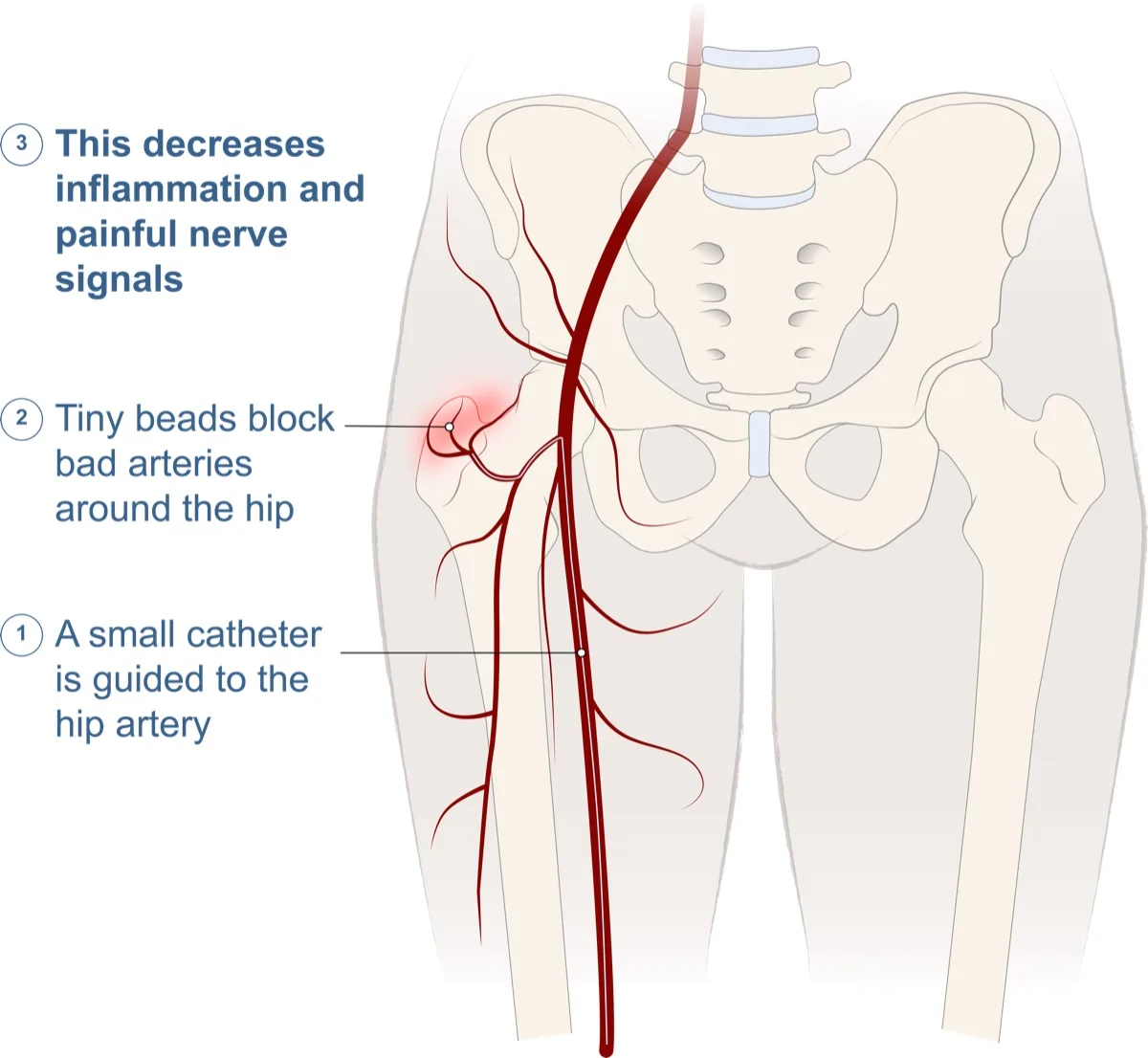
Embolization for hip pain is newer and less proven than our knee work. The published studies are small, single-arm, and come from a limited number of centers — the largest followed 49 patients and found meaningful improvement in roughly three quarters at 12 months. There are no randomized controlled trials yet.
Safety data across musculoskeletal embolization has been reassuring. But you deserve to know where this sits, and it sits earlier than we'd like. If someone quotes you a success rate without that context, be skeptical.
If you've run out of options, it's worth a conversation.
Take the quick assessment and find out whether embolization could help — and what your insurance covers.
See if I'm a candidate